


Every autumn the forest becomes easier to photograph, which is a paradox, because it also becomes darker. Photographing in the forest at this time of year means taking advantage of a canopy that thins out, finally lets light through and pushes warm tones all the way into the shadows. We rarely head out with more than a body, two lenses and a cloth. Everything else comes down to the hour we choose and the weather that morning.
What autumn changes under the trees
In summer, undergrowth is a green wall. The canopy is dense, it blocks the light and creates hard patches that no amount of editing will recover. By October the same patch of woodland lets through far more light, and above all coloured light: yellow and russet leaves behave like an enormous filter that warms everything passing through them. Wet trunks, meanwhile, turn almost black, which finally gives the picture some structure.
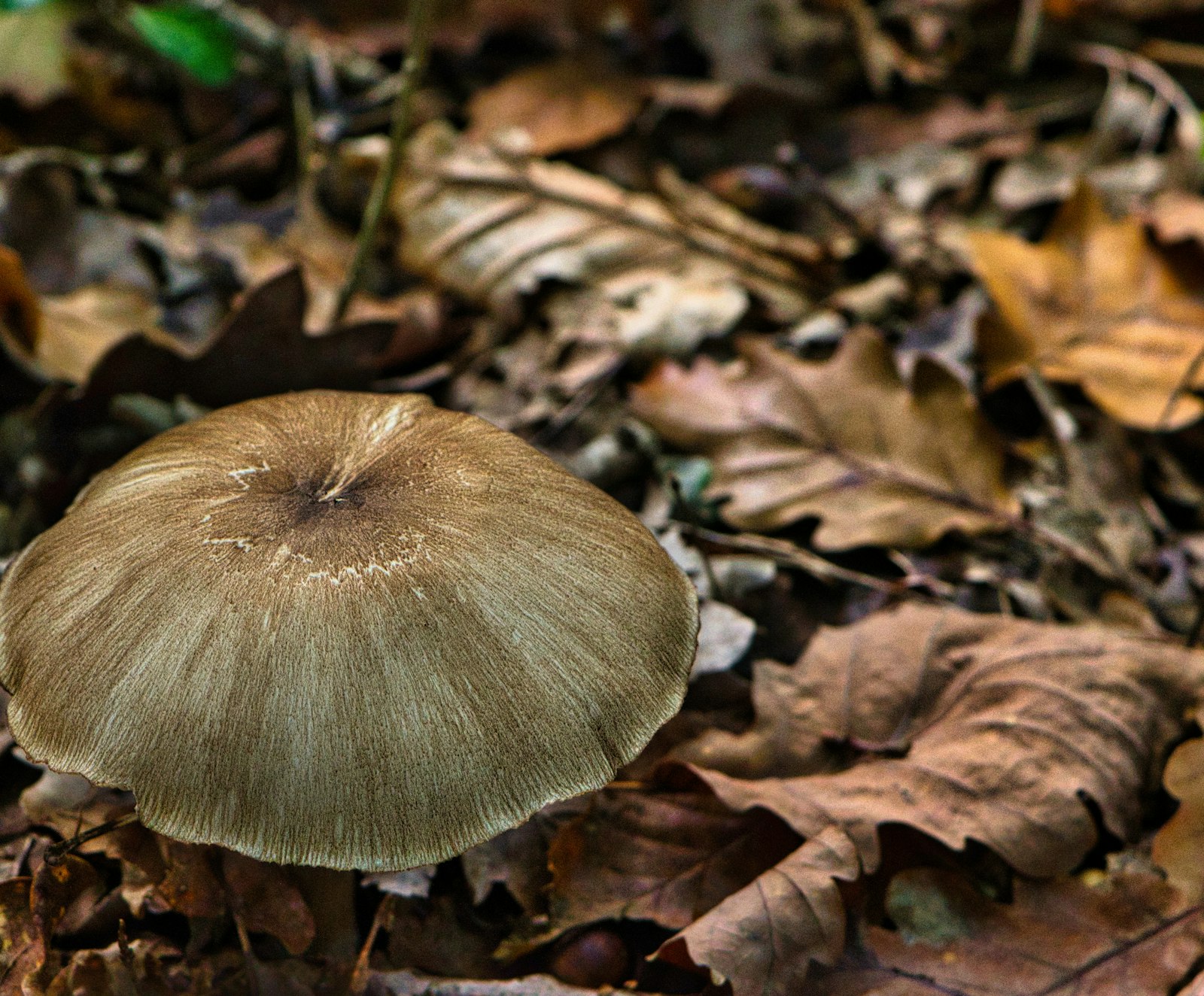
The second change happens at ground level. The leaf litter bounces light upwards and softens the shadows on mushrooms, roots and stones. It is the one season when you can photograph details on the forest floor without reaching for a reflector.
The hour you go out decides the picture
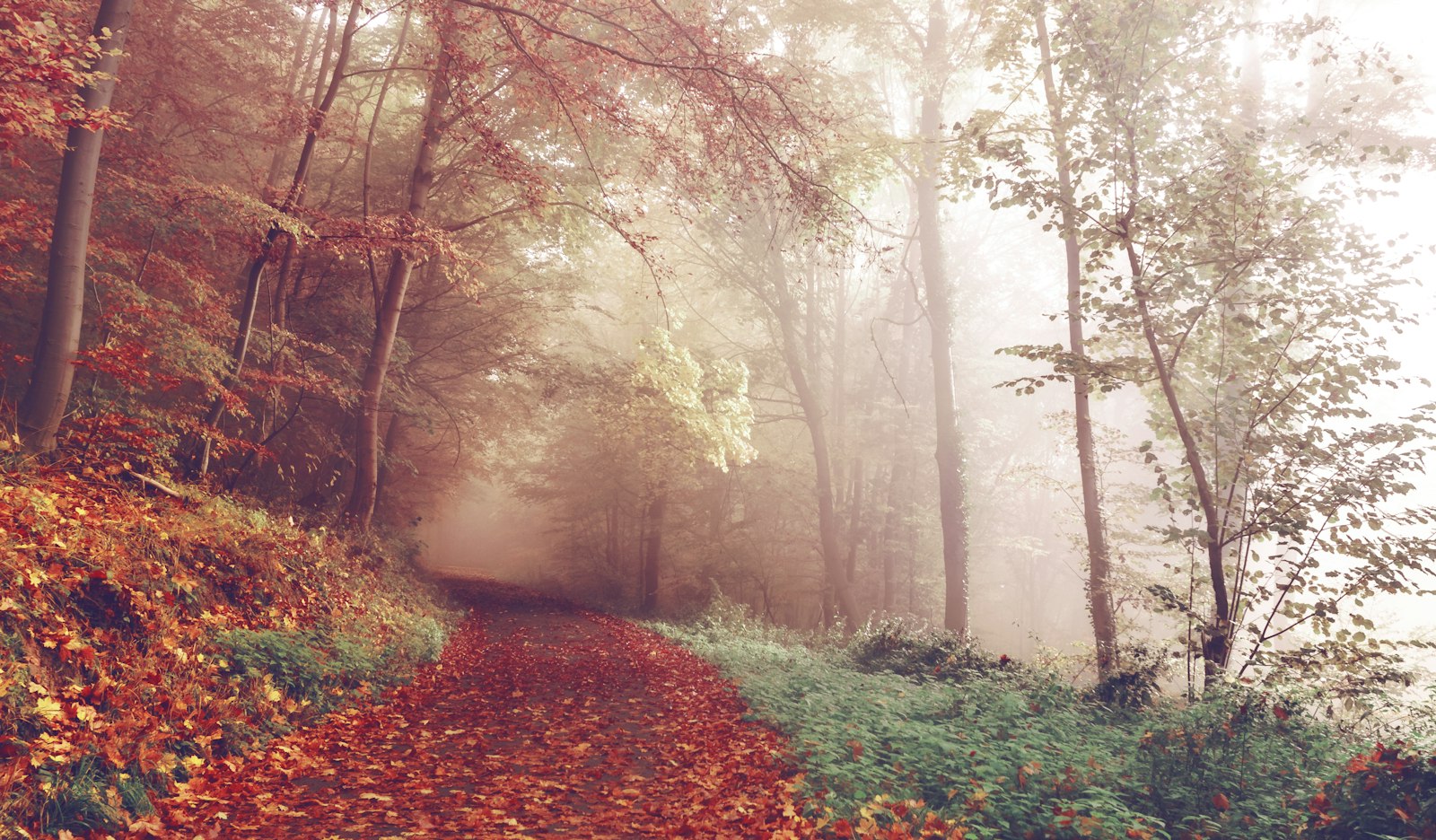
Early morning, for the mist
Mist is the reason we get up before daylight. It forms after a cold night on ground that is still damp, and it settles mainly in hollows and along streams. Its value is mechanical: it separates the planes. The foreground stays sharp and dark, the background washes out gradually, and that natural falloff creates a depth no camera setting can imitate. It rarely holds for more than forty minutes after sunrise, so we scout the spot the day before.
Late afternoon, for the backlight
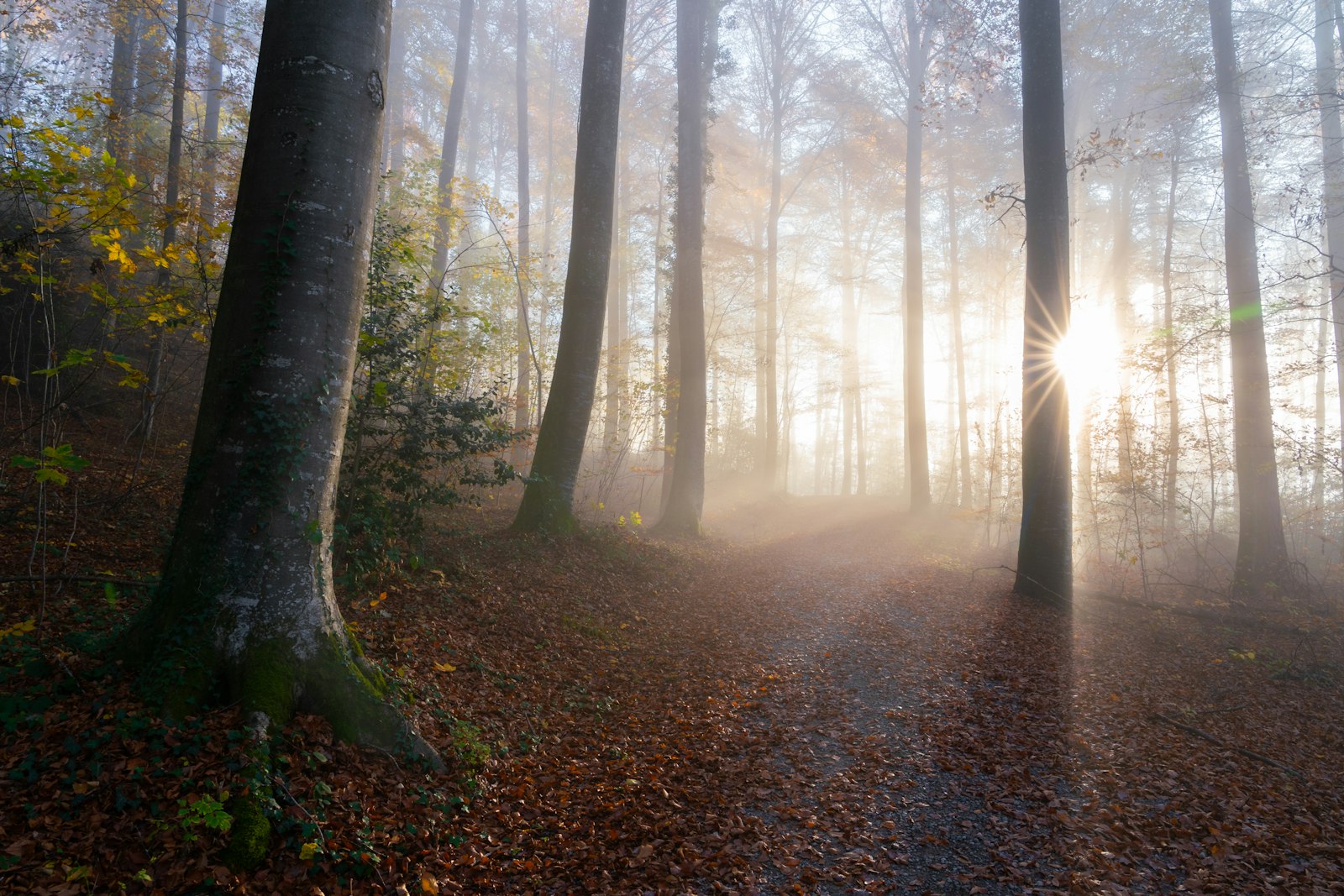
At the end of the day the sun travels horizontally between the trunks. Standing so that it faces you gives translucent leaves, rays drawn by dust and moisture, and very graphic silhouettes. You have to accept a little flare, or control it simply: a hand held above the lens, or a trunk placed directly in front of the sun, is enough to bring the contrast back.
Between those two extremes there is overcast weather, which everyone underestimates. A grey day is an enormous softbox: not a single hard shadow, dense colours, and russets that come out cleanly. We deliberately save days of light rain for close-ups, when water on the leaves does the saturation work for us.
Settings that hold up under the trees
Aperture comes first
A forest is visually disordered, and aperture is our first sorting tool. Between f/4 and f/5.6, an isolated subject lifts away from the clutter and the background becomes a mass of colour. For a full woodland landscape, where the ground matters as much as the canopy, we close down to f/8 or f/11. If that vocabulary still feels vague, the mechanics are covered in our article on the exposure triangle.
Shutter speed, sensitivity and stability
Light is low, and that is the permanent trade-off of the season. Handheld, we do not go below 1/100 s with a 50 mm, and we push ISO to 1600 or even 3200 without hesitation. Noise from a recent sensor is easy to deal with in editing; camera shake is not. The tripod only comes out for long exposures over a stream, between a quarter of a second and a full second, with a two-second timer to avoid the vibration of the shutter release.
Exposure and white balance
Mist fools the automatic meter: the camera sees a bright scene, underexposes, and hands back a dirty grey. We correct by +0.3 to +0.7 EV when shooting it. Backlight works the other way round, so we underexpose slightly to protect the highlights and lift the shadows afterwards. All of this assumes shooting in RAW, and setting white balance around 5500 K rather than letting the automatic mode neutralise the very warm tones we came for.
Composing when there is no horizon
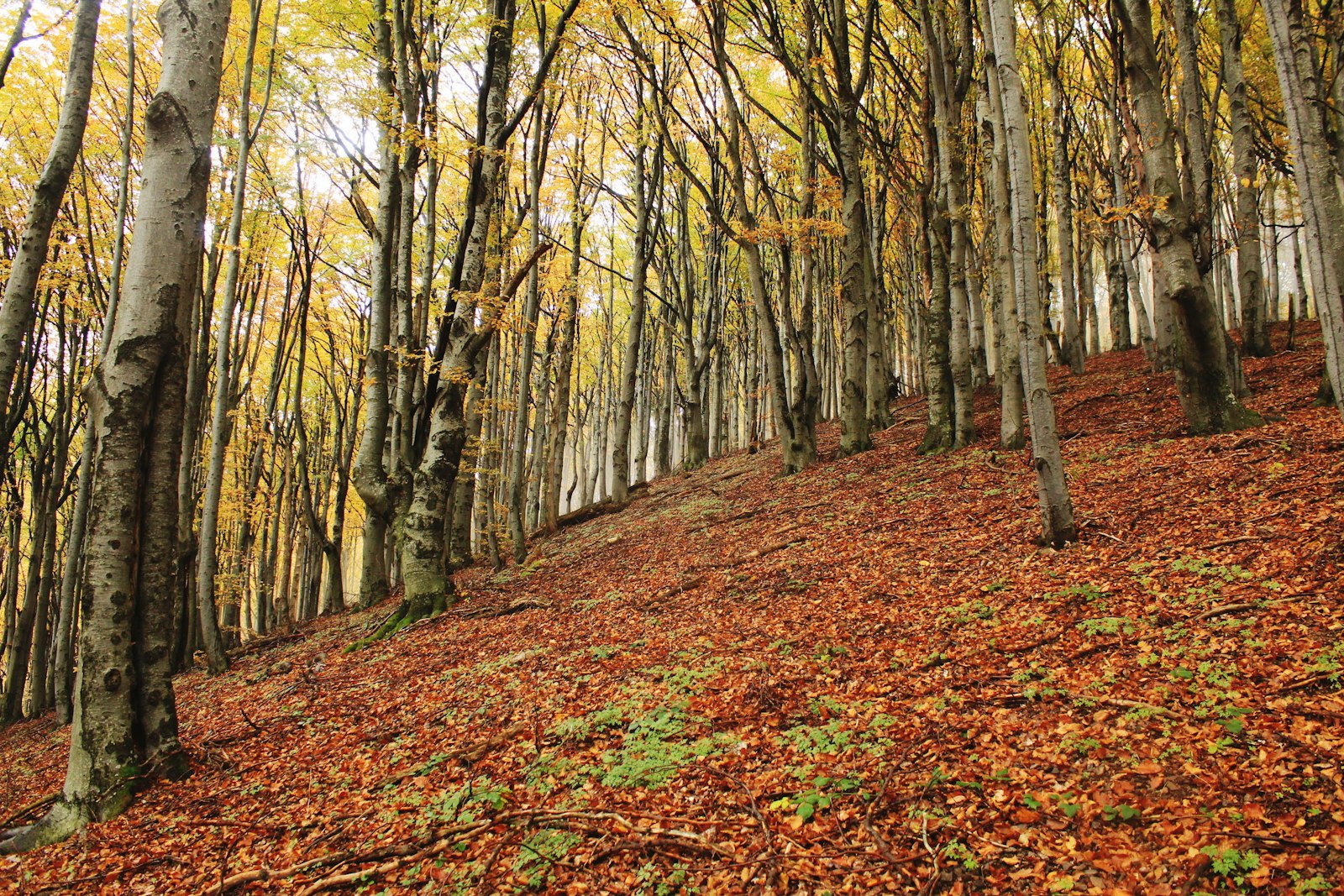
A forest offers no horizon line and no obvious vanishing point, which is what makes composition difficult. So we look for repetition, because it organises the chaos: the vertical alignment of trunks, a path heading away, a gap full of light, or a single red leaf against a green background. When nothing stands out, we crouch. A large share of our autumn pictures were taken on our knees, thirty centimetres off the ground, where the leaf litter becomes a foreground.
The telephoto lens remains the most underused tool in woodland. An 85 or a 135 mm compresses the planes, pulls the trunks towards each other and builds a pattern where the eye saw only a tangle. It is often that focal length that brings back the most readable frames of the day.
The one accessory that really matters
If we could take a single accessory, it would be a circular polarising filter. It removes the white reflection from wet leaves and rocks, and the colours return at once, with no editing at all. You simply have to avoid turning it all the way: at full polarisation, a patch of sky visible between the branches goes an unreal blue and gives the picture away. The second item is humbler, a microfibre cloth, because a lens covered in tiny droplets can ruin an entire morning. For long exposures over water, a light travel tripod is more than enough.
Back home, editing does half the work
The most common mistake is to push the global saturation slider: russets turn fluorescent orange and the photograph starts to look like a desktop wallpaper. We work colour by colour instead, lowering the luminance of the yellows slightly to give them density back, warming the oranges only a little, and desaturating the greens, which tend towards the fluorescent on recent sensors. On misty frames, the dehaze slider deserves extreme restraint: too much correction erases exactly what you went out to find. We described how we handle these files in our article on photo editing and today's tools.
What the forest gives back to the studio
These outings are not only there to fill an image folder. Wet bark, fog swallowing a path, low light between two trunks: these are direct references for the sets, moods and textures of our narrative projects. We photograph as much for the walk itself as to build a bank of real material, the kind that saves you from starting with a generic image when a place has to feel credible.
Autumn lasts six weeks, sometimes less depending on the wind. It is short, and that is probably why we go back every year with the same impatience.



0 Comments