


We are at the beginning of the 1990s, the video game console market is still dominated by Nintendo with its Famicom, in competition with Sega's Master System. Big N still benefits from the enormous success of the Game Boy, the first true portable console, launched in 1989.
The early 1990s were one of the most creative periods in video gaming. "It was a sort of golden age where many genres were created," noted one journalist.
Indeed, the arrival of 16-bit consoles—the Super NES and the Mega Drive—opened up the field of experimentation for creators. People now spoke of different genres: fighting (imposed by Street Fighter II), platformers (dominated by Mario and Sonic), RPGs (with Final Fantasy and Zelda), and racing games.
The first console war between Nintendo and Sega also began, personified by their respective mascots Mario and Sonic. A marketing and commercial war that would define the video game landscape of the 1990s.
1993: the PC confirms its dominance on the video game market
The year 1993 marked a turning point in the gaming industry. Since 1985, arcades had been deserted. They would find significant attendance again from 1995, mainly in Japan where Sega made its games Virtua Fighter and Daytona USA into real successes. But the rest of the world had moved on to home gaming.


In the 16-bit console market, sales collapsed at a rate of 20% per year while awaiting the arrival of the Japanese company Sony and its PlayStation console. Nintendo saw its revenue decrease by 23.5%, or 4.7 billion dollars, but had a cash reserve strong enough to weather the storm.
Personal computers underwent technical improvements that would propel them to become full-fledged gaming stations. The CD-ROM, introduced for the first time in 1992, became widespread on PCs and subsequently on consoles. This new storage medium could hold 650 MB of data, compared to only a few MB on cartridges.
Between 1993 and 1997, the average purchase price was divided by three while performance multiplied tenfold. This democratization of the PC transformed the gaming landscape permanently.
1995: Sony enters the arena
In late 1994, Sony launched the PlayStation in Japan, marking the entry of a new major player in the console market. The machine, powerful and affordable, would quickly win over gamers worldwide.
The PlayStation benefited from an extensive game catalog and a clever marketing strategy targeting an older audience than Nintendo's traditional base. Titles like Final Fantasy VII, Metal Gear Solid, and Resident Evil became cultural phenomena.

Nintendo responded in 1996 with the Nintendo 64, a technically impressive console that maintained the cartridge format. While it produced iconic games like Super Mario 64 and The Legend of Zelda: Ocarina of Time, its limited storage capacity compared to CDs put it at a disadvantage.

In November 1994, the Sega Saturn launched in Japan and in May 1995 in the United States, four months ahead of schedule, at a price of $400. The PlayStation was launched in early December 1994 in Japan at a more competitive price, giving Sony a decisive advantage.
Despite a clear recovery between 1994 and 1995, where the number of consoles sold went from 10.5 million to 14.3 million, the market was far from its 1992 performance (27 million consoles sold). The PC continued to grow as a gaming platform, fragmenting the market.
1996: the web and video games
The first developments of the Web in the gaming field concerned downloading patches. These were game update files provided by the publisher to fix potential defects.
Players could also access, on specific websites, "cheat codes" (codes allowing cheating by, for example, making the game character invulnerable) and "walkthroughs" for players having difficulty completing a chapter of the game.
Additionally, add-ons—files that provide access to game supplements (additional maps, music or sounds, weapons, game textures…)—were made available either by the publisher or by passionate players/programmers.
Finally, the Web enabled the distribution of software in the form of "shareware." They were distributed for free and only paid for if the user was satisfied with the product. This model, pioneered by id Software with Doom, would influence the future free-to-play model.
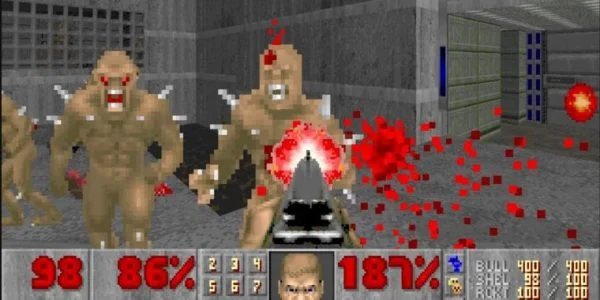
The late 1990s also saw the emergence of online gaming. Games like Ultima Online (1997) and EverQuest (1999) pioneered the MMORPG genre, creating persistent virtual worlds where thousands of players could interact simultaneously.
StarCraft (1998) by Blizzard became a global esports phenomenon, particularly in South Korea where professional gaming leagues were established. This laid the groundwork for the competitive gaming industry.
Half-Life (1998) by Valve revolutionized the first-person shooter genre with its narrative approach and immersive storytelling, setting new standards for single-player gaming experiences.
The 1990s ended with Sega launching the Dreamcast in 1999, the first console with built-in online capabilities. Despite its technical innovation, it would be Sega's last console, as the company could not compete with the upcoming PlayStation 2.

The 1990s were a decade of transformation for the video game industry. The transition from 2D to 3D, the rise of the PC as a gaming platform, the arrival of Sony, and the beginnings of online gaming all shaped what the industry would become in the new millennium.
The next decade would bring even more revolutionary changes with the rise of mobile gaming, social games, and the explosion of online multiplayer experiences.
Continue the series
Previous article: The history of video games: the 1980s
Next article: The history of video games: the 2000s



0 Comments